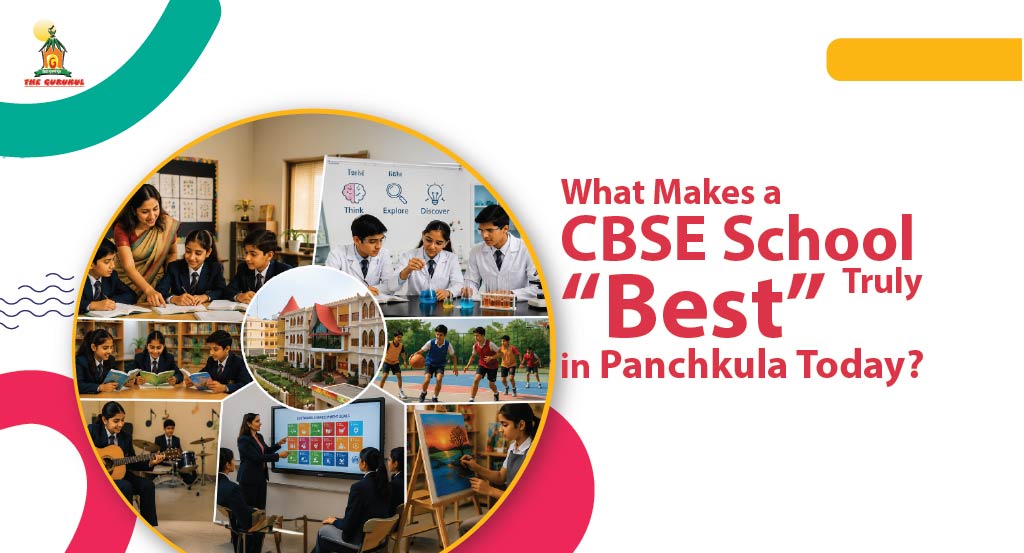
There is something quietly exhausting about school admission season if you have been through it. Not because the schools are bad or the choices are limited, actually in Panchkula the options have gotten genuinely good over the last several years, but because every school you visit starts sounding like the last one.
Holistic development. Academic excellence. Child-centric learning. The words are identical across brochures, across websites, across every principal’s office you sit in. And somewhere around the third or fourth visit you stop hearing the words and start trying to feel what the place actually is, which is probably what you should have been doing from the beginning.
Parents who are honest about this process will tell you the decision eventually came down to something they noticed during a campus visit that they could not quite explain. A teacher who crouched down to talk to a small child in the corridor. The particular quality of noise from a classroom they passed. Something about whether the children on campus looked like they were somewhere they had chosen to be or somewhere they had been deposited. These things are not in any ranking system but they tend to matter more than most things that are.
Also Read – Best Schools in Panchkula With Fee Structure
The Classroom on a Day When Nothing Special Is Happening
Results are real and worth looking at but they are a trailing indicator, the last thing that happens after a long chain of other things, and what produced them — or quietly failed to — is what happens in classrooms on completely ordinary days. The days that are not exam week, not open day, not the week before the annual function.
The regular Tuesday in the middle of a term when a teacher is explaining something for the second time because half the class did not get it the first time and the teacher noticed. That noticing is the thing. The best CBSE schools in Panchkula tend to have it in ways that show up even during a short visit. A wrong answer that gets built on rather than moved past. A child who asks something that derails the planned lesson and a teacher who follows the question rather than rerouting back to the notes.
Students who look like they are actually thinking rather than waiting to be told what to write down. None of this is dramatic. It does not look like anything special when you see it. But twelve years of that kind of classroom adds up to something very different from twelve years of the other kind, and most parents can tell the difference between the two when they see them even if they could not have described the difference beforehand.
Infrastructure and What It Actually Tells You
Most schools in Panchkula have reasonable infrastructure now and most of them will show it to you during a visit. The labs, the computer rooms, the sports facilities, the library with full shelves. What they will not always tell you is how often those things are used and by whom and for what.
A lab that is opened for campus tours and locked on regular school days has a particular quality to it, a cleanness, an orderliness, an absence of the small messiness that comes from actual use. A library where children borrow books has scuffed shelves and a system that is slightly imperfect because it is being lived in rather than maintained for appearances. This is one of the more honest things you can assess during a visit to good schools in Panchkula without having to ask anyone anything. Just look.
Look at whether the benches in the science lab show signs of being worked at. Look at the sports schedule on the notice board and whether it is current. If you happen to pass a child in the corridor ask them when they were last in the library and what they borrowed. The answers are almost always more informative than the formal part of the visit.
The Personal Attention Thing and What It Actually Means
Every school says it. Not every school means it in the same way. There is a version of personal attention that is about class size, about having fewer students per teacher than the school across the road. That version is not meaningless but it is not the whole thing either. The actual thing, the version that changes outcomes for individual children, is whether teachers carry specific knowledge of the children in their classes. Not their rank. Not their general performance level.
The particular confusion they have about a specific concept. The way they engage in discussion versus on paper. The thing they are more capable of than their marks have so far shown. Children who are known this specifically by their teachers do not accumulate quiet confusion the way children in anonymous classrooms do. The small gap in understanding in Class 4 that nobody caught and that becomes a structural problem by Class 7 — that is what happens when personal attention is a phrase rather than a practice.
When you are sitting with a school during an admissions conversation, ask them something specific. What happens when a child is struggling with something and not raising their hand. How does the teacher know? What happens next? The answer to that question, and the confidence or hesitation with which it comes, tells you more than the rest of the conversation probably will.
Know More – Top Schools in Chandigarh
Safety in the Way That Actually Matters
A camera at the gate and a guard at the entrance are the visible parts and they are not nothing. But the version of safety that determines whether a child can actually concentrate and grow at school is more internal than external. It is about whether the social environment inside the school is one that adults are genuinely paying attention to. Whether a child who is having a hard time, not academically, just socially, just in the way children sometimes have a hard time — has somewhere to take that and someone to take it to.
This quality is visible on campus during a normal school day in a way it is not really visible during a formal open event. Children who feel genuinely safe somewhere carry themselves differently from children who are navigating something. You can usually feel the difference within the first ten minutes of being in the right kind of school and the best school in Panchkula will have this quality in a way that does not need to be pointed out to you.
The Twelve Year Question
The schools that produce people who are genuinely capable and confident and functional in the world beyond education are almost always the ones that took the other things seriously alongside the academic ones. The Gurukul in Panchkula has been working at this combination for long enough that it shows in the campus in ways that become clear once you are actually there.
FAQs
1. What should parents really be looking for when choosing the best school in Panchkula?
What the school feels like on an ordinary day when nothing is being performed for anyone. The teaching culture in unremarkable moments, how the campus feels when children are just going about their day, whether the staff seem genuinely present or professionally distant. These things do not appear in rankings but they tend to determine what twelve years of schooling actually produces.
2. How do the best CBSE schools in Panchkula approach teaching differently?
They build real understanding rather than exam-calibrated performance, which shows in specific teaching behaviours that are observable during a visit. How wrong answers get handled. Whether questions from students are followed or redirected. Whether children seem genuinely engaged or only compliant. The difference is visible once you know to look for it.
3. How do you tell whether infrastructure is genuinely used at good schools in Panchkula?
Look for signs of actual use rather than careful presentation. A science lab that is regularly worked in looks different from one opened for tours. A library with a real reading culture shows in its shelves and its systems. These things are observable during a visit and they tell a more honest story than the formal tour does.
4. What does personal attention actually look like in practice?
Teachers who carry specific knowledge of individual children — not rankings but actual understanding of how a particular child learns, where they get stuck, what they are more capable of than their written work shows. Asking a school directly what happens when a child is quietly struggling tends to reveal very quickly whether this is a value or a phrase.
5. How should parents think about safety when evaluating schools?
Beyond the visible security infrastructure, look at whether children on campus seem genuinely settled rather than monitored. Ask how social difficulties get noticed and addressed. A school where children feel internally safe — not just physically secure — has a particular quality of ease on campus that is perceptible during any honest visit and that matters enormously for learning over time.
Tags: Best CBSE schools in Panchkula, best school in Panchkula, Good schools in Panchkula