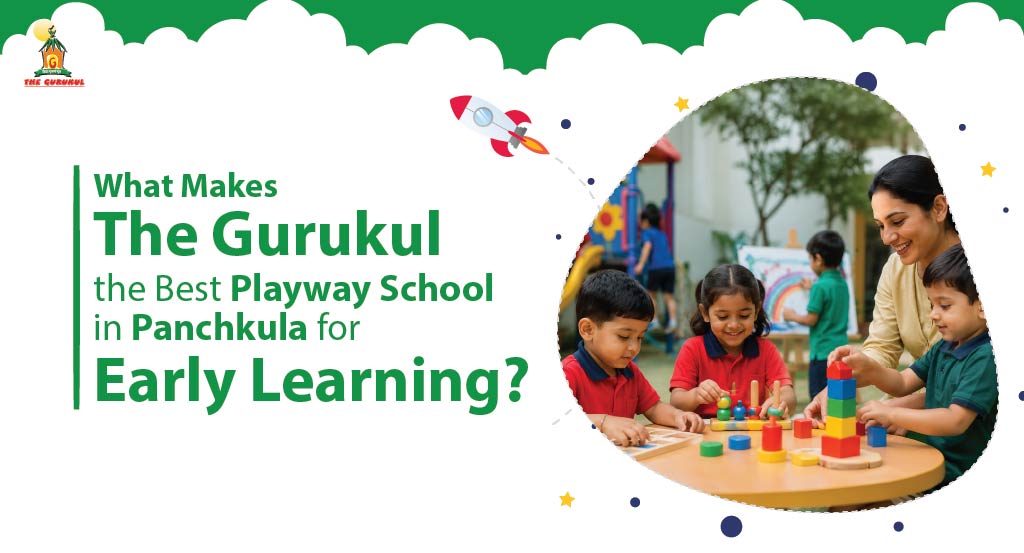
What Makes The Gurukul the Best Playway School in Panchkula for Early Learning?

The decision of which school your child should attend is a big one. The formative years of learning are crucial since they lay the foundation for the future of a child. It is during this stage that children learn how to think, talk and relate with other people. This is why parents seek a playway school where the emphasis is on learning and happiness.

The Gurukul is regarded as one of the best playway school in Panchkula as it strikes the proper balance between fun and education. It concentrates on general growth and assists children in growing with confidence.

Let us understand why the Gurukul is such an excellent early learning choice.

Also Read – Affordable Pre Primary Schools Near Panchkula

A Child-Centered Approach to Learning

At The Gurukul, every child is treated as unique. The playway school in Panchkula realizes that every child studies at their own pace. Instead of putting pressure, teachers guide children in a gentle and supportive way.

It is not just about academics but also the development of confidence, curiosity and communicative abilities. Children are prompted to ask questions and seek new concepts. This renders learning natural and fun.

Safe and Comfortable Environment

A safe environment is very important for young children. The Gurukul has a clean, safe and child-friendly environment where children feel at ease.

The classrooms are well-lit and roomy and are designed in a way that makes learning fun. Safety is also taken seriously with proper monitoring and trained staff. Transport facilities are also managed carefully to ensure children travel safely.

Children will feel safer, becoming more active and receptive to new things.

Learning Through Play and Activities

The Gurukul adheres to the playway approach, according to which the children are taught via activities, games, and enjoyable experiences. This approach allows kids to comprehend the concepts more effectively without being stressed.

It has activity rooms, storytelling corners and creative areas where children can use their imagination. Books are not the only way to learn. Rather, children are taught through experience, and the process becomes more effective.

The best playway school in Panchkula also incorporates contemporary features such as smart classes to make lessons interesting and engaging.

Caring and Experienced Teachers

Teachers play a very important role in early education. The Gurukul teachers are well-trained, patient and caring.

They know how to treat young children with love and care. Every child receives one-to-one instruction depending on their needs. The teachers are also continually enhancing their competencies in order to offer the best learning experience.

This positive atmosphere makes children feel safe and joyful at school.

Read More – How to Prepare Your Child for Playway School in Panchkula

Focus on Overall Development

The Gurukul is of the opinion that learning is not only through studies. Children are supposed to develop in all aspects of life.

It has numerous activities available in school, such as art, dance, music and drama. Such activities assist children in expressing themselves and developing creativity. Physical development is also through sports and outdoor play.

This moderate way is the assurance that children like school and acquire valuable life skills.

Building Values and Good Habits

It is important to develop strong values early in life. The Gurukul is concerned with discipline, honesty and respect.

Children are taught how to act, share with others and be responsible. The school also promotes awareness of society and the environment.

The values enable children to develop into responsible and nice people.

Modern Infrastructure for Better Learning

The Gurukul offers contemporary amenities, which were specifically tailored for young learners. Both learning and fun are assisted by the well-planned classrooms and areas of activity.

There are intelligent classes, innovative areas, and learning resources that make learning more engaging. The surroundings will be such that the children will be interested.

Learning is greatly facilitated by good infrastructure that makes it enjoyable.

Strong Connection with Parents

The Gurukul is of the view that parents play a significant role in the education process of a child. The school keeps parents updated on the progress of their child by updating them frequently.

This effective communication also makes parents remain engaged and contribute to the development of their child at home. Children are the greatest beneficiaries when parents collaborate with the schools.

Conclusion

The early years of a child’s life are very important. A good playway school Panchkula should create a space where children feel safe, happy, and excited to learn.

The Gurukul provides just that. It offers a good foundation to young children with its caring teachers, modern forms of learning, a safe environment and emphasis on values.

If you are looking for a playway school in Panchkula that focuses on both learning and overall development, Gurukul is a great choice for your child’s early journey.

FAQs

1. What is the playway method in The Gurukul?
The playway approach implies that children study games and fun activities rather than traditional ways of studying. This renders the learning process easy and fun.

2. Is The Gurukul a secure school among young children?
Yes, The Gurukul is safe and child-friendly with adequate safety measures and trained personnel to attend to children.

3. What are the activities provided to develop overall?
The school provides such activities as art, dance, music, drama and sports to enable children to develop in all aspects of life, rather than merely in academics.

4. Why is The Gurukul a good early learning institution?
The Gurukul is an excellent option since it offers fun education, good values, nurturing educators and facilities to help a child develop fully.


Tags: , ,

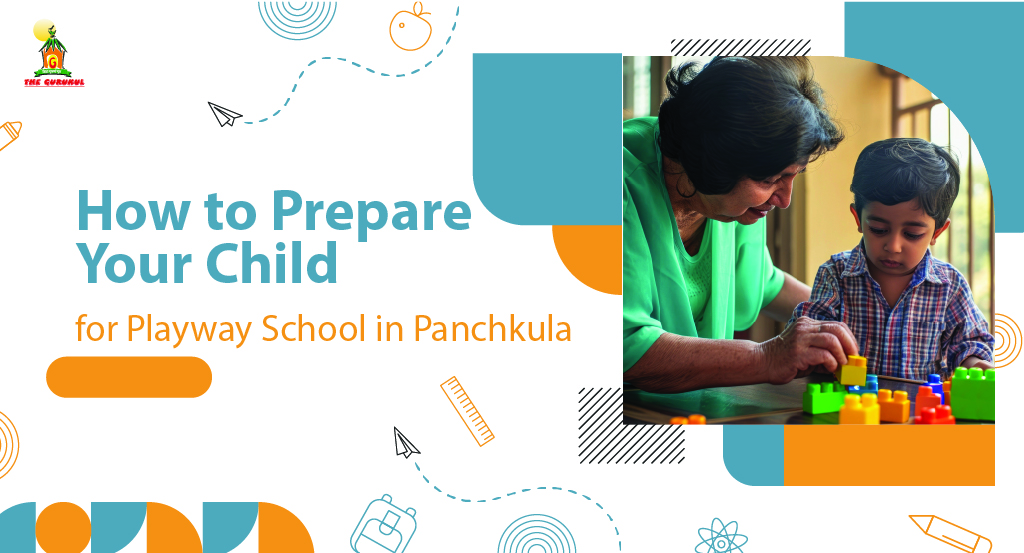
How to Prepare Your Child for Playway School in Panchkula

Nobody really warns you about the first morning. Not in a useful way anyway. People say things like it’ll be fine and they settle quickly and before you know it they’ll love going, all of which may be true but none of which helps you much when you are standing at a school gate at nine in the morning with a child who has attached themselves to your leg and is looking up at you with an expression that you are going to carry around for the rest of the day regardless of what your calendar says. 

Some children walk straight in. Some do not. Neither one means anything particular about the child or about what comes next. What it mostly means is that something new is happening and new things are hard before they are ordinary, which is true for everyone at every age and does not stop being true just because we have gotten better at pretending it is not. The morning itself, though, is mostly just the moment when everything that came before it shows up at once. The weeks before it are where the actual preparation happens, and most of it is quieter and less deliberate than the word preparation suggests.

Separation Is the Thing, Not Anything Else

There is a version of school readiness that parents sometimes focus on, letters, numbers, colours, knowing their own full name, and none of that is the real thing at playway school age. The real thing, the thing that actually determines how the first weeks go, is whether the child has enough experience of being away from the people they feel safest with to know somewhere underneath conscious thought that it is not dangerous. 

That the parent goes and comes back. That a room full of strangers is uncomfortable and not catastrophic. That the feeling of newness, which is genuinely unpleasant at three years, is a feeling that passes rather than one that means something has gone wrong. This knowing does not come from being told it. You cannot explain your way to separation tolerance with a child who has not yet experienced it. It comes from small repeated experiences of being left somewhere and being fine and being collected and finding that everything is exactly as it was before. 

It has to happen more than once, and it has to end with the child finding that you came back, because the ending is what accumulates into the internal evidence that makes kindergarten schools in Panchkula feel survivable rather than threatening. The children who find the first days hardest are often the ones for whom this is genuinely the first extended time away from home, which is not a character flaw and not a failure of parenting, it is just a gap in experience that has to be filled somehow and is easier to fill gradually before school than all at once inside it.

Also Read – Top Qualities to Look for in the Best Schools in Panchkula

What a Home Routine Does That Nothing Else Does

Playway school in Panchkula runs on a schedule. Morning circle, snack time, activity time, rest, pickup. This is obvious but the implications are not always obvious. A child who has been living in a household where the day happens more or less as it happens — meals when people are hungry, sleep when tiredness arrives, activities when they arise — is making two adjustments simultaneously when school starts. 

Some sense of what comes after what. Young children find unpredictability tiring in a way that does not always look like tiredness from the outside. It looks like irritability and difficulty transitioning and emotional reactivity, because the brain at three years old is working hard to anticipate what comes next and when it cannot, the workload shows. 

A child who has a working internal map of the day carries less of that cognitive and emotional load into new situations, which means the newness of school has slightly less to compete with. Sleep is the part of this that matters most and is most directly in parents’ hands. A well-rested three year old and an overtired one are not slightly different versions of the same child on a given morning. 

They are genuinely different in what they can manage, in how much social and emotional processing they have capacity for, in how quickly the discomfort of something new tips into real distress. Getting sleep stable before the first week of playway school is the single most useful practical thing most parents can do and also the least complicated.

How School Gets Talked About at Home

This one tends to get underestimated. Children do not wait until the first day to form their sense of what school is going to be. They form it at home, over weeks, in the tone and the specific words of how the adults around them describe it. A parent who is genuinely worried about how their child will manage, which is a completely understandable thing to be, communicates that worry in very specific ways. 

After lunch is important because three year olds do not have workable abstract time. They cannot hold it in ninety minutes. They can hold in after lunch because lunch is concrete and familiar and something they have experienced before. If you know the teacher’s name before the first day, using it at home in the days before means there is at least one person in that room who is not a complete stranger. Just a name, used naturally, a few times. That is enough to make a small difference.

Read More –  Best CBSE Schools in Panchkula in 2026

The Drop-off That Does Not Go Smoothly

Some mornings are hard regardless of how well everything went before them. A child who was fine all week has a difficult Tuesday for reasons that are not always traceable to anything. This happens and it does not mean the preparation failed or the school is wrong or the child is not ready. It means Tuesday was hard, which is information but not a crisis. The thing that makes hard drop-offs harder, reliably and almost universally, is the extended goodbye. 

A goodbye that is brief and warm and specific, an actual hug, an after lunch, a clean leaving,  is almost always kinder than one that tries to ease the distress by prolonging it. The teachers at a good playway school in Panchkula have seen this pattern many times and know that most children are fine within a few minutes of the parent actually leaving. They can tell you at pickup exactly how quickly it settled. 

The Gurukul in Sector 20 Panchkula is built around this specific transition. The early years environment there is designed with the understanding that how school begins shapes a great deal of what follows, and that the first weeks matter in ways that go well beyond what they look like on the surface. For families in Panchkula at this stage, thegurukul.guru is worth a real look before the seats fill up.

FAQs

1. What matters most before a child starts playway school in Panchkula?

Experience of being away from primary caregivers and finding it manageable. Not the idea of it but actual repeated experience, playdates without parents, time with familiar family members, new environments navigated with someone other than you. This is what builds the quiet internal confidence that makes the first days of school something a child can move through rather than something that overwhelms them.

2. How early should preparation for kindergarten schools in Panchkula start?

Two to three months is a useful window for the gradual things, building separation experiences, loosely establishing a home routine, getting consistent sleep. Nothing intensive, just small and repeated so that school is not the first time any of it is being encountered.

3. How should parents talk about school at home before it starts?

Plainly and confidently rather than reassuringly. A specific description of what will happen, a concrete return time that a three year old can actually hold onto, and the teacher’s name if you know it. The emotional tone of how school gets talked about at home is the thing the child absorbs and carries to the gate.

4. What helps when drop-off is genuinely hard?

A goodbye that is warm and brief and then actually finished. Not extended in the hope of easing the distress because extension tends to prolong it by keeping the leaving uncertain. Most children settle within minutes of the parent leaving and the teacher can tell you how quickly at pickup, which is more useful information than anything you will find by calling mid-morning.

5. Why does sleep matter so much before starting playway school in Panchkula?

Because the gap between a rested young child and a tired one in terms of what they can emotionally and socially manage is genuinely large, not marginal. Newness is demanding at three years old even under good conditions. A child arriving already depleted has considerably less capacity to meet those demands, and no amount of other preparation compensates for it as directly as sleep does.

Tags: , ,